Knot Theory (April 15th, 2025)
In this meeting we talked about knot theory!
A mathematical knot is a knot made from an infinitely thin, stretchy length of string, often with the two loose ends joined up. We say a knot is an embedding of a 1-dimensional circle into 3-dimensional space, where embedding means that the circle does not intersect itself. Knots are important objects studied in (Low-Dimensional) Topology in the subtopic of Knot Theory. These are popular objects for undergraduate research projects because they are easy to work with but have very deep underlying mathematics.
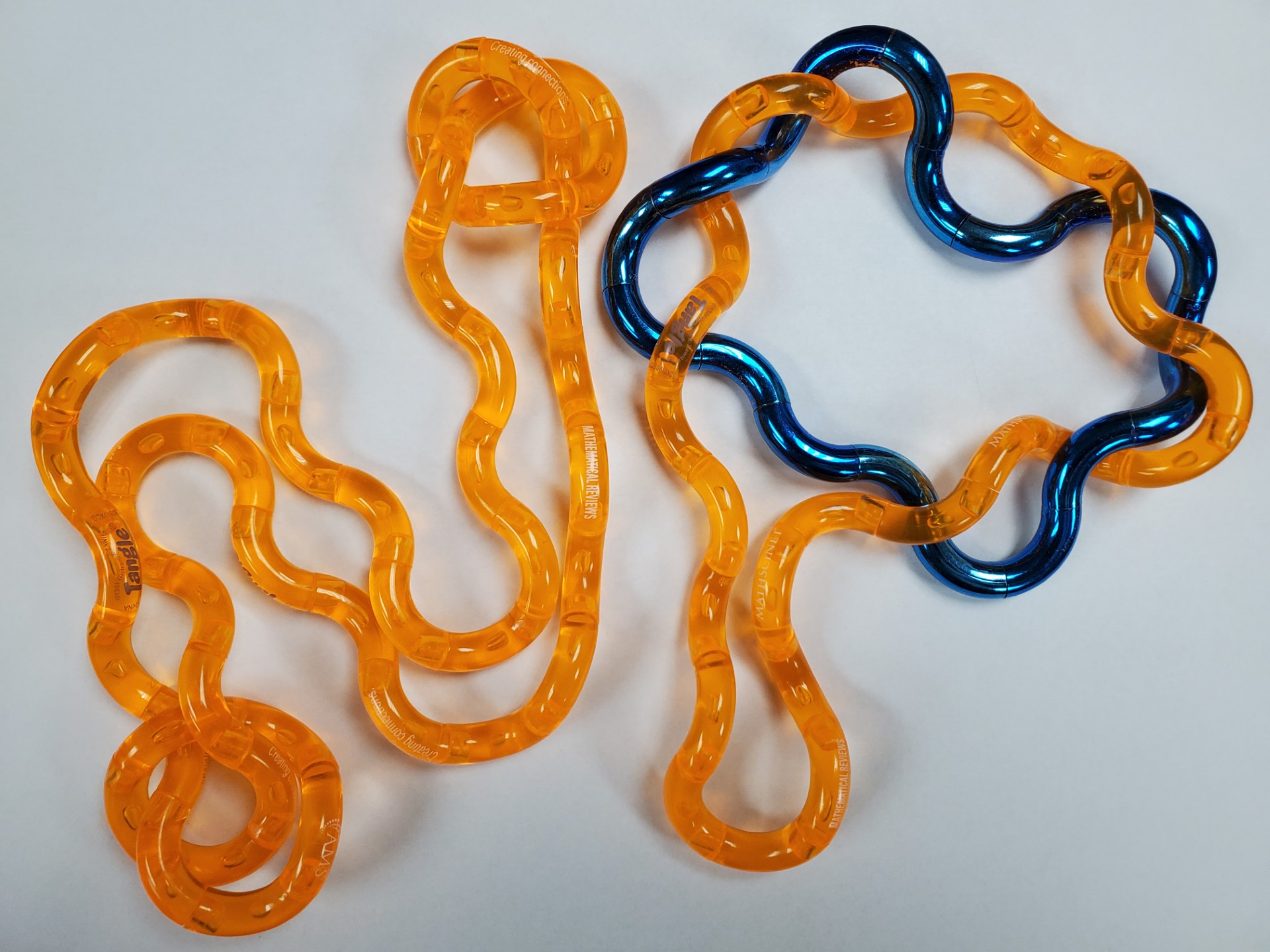
Knot theorists like Dr. Cohen often draw 2-dimensional knot diagrams which look like shadows of the knot with the rule that a strand may only pass over one strand at a time (no triple or higher points). These double points are decorated with under- and over-crossing information. These objects might remind you of similar mathematical objects called graphs studied in discrete math or combinatorics or graph theory.
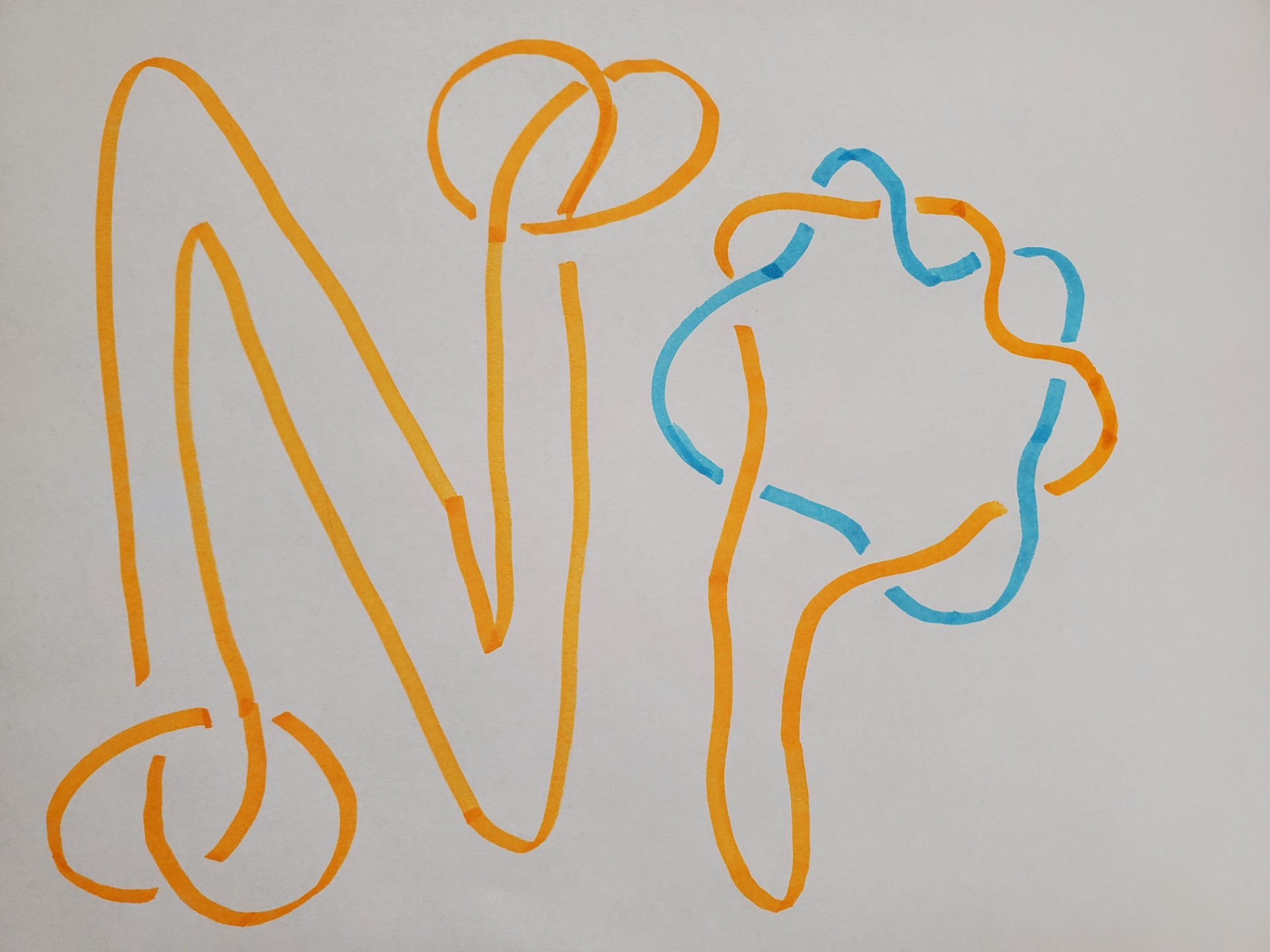
The math club practiced tying knots and then drawing knot diagrams based on them. Knot theorists like to use knot invariants to distinguish knots. One of these is called tricolorability, which generalizes to n-colorability. This refers to the number of colors n needed to color the arcs of a diagram satisfying certain properties. These properties are related to concepts in abstract algebra including group theory and representation theory. The math club used tricolorability to distinguish the knots they created.
Dr. Cohen used this meeting to recruit students for his research group in Fall 2025 that went on to write this paper submitted for publication with student co-authors!
If there are any students interested in these topics, they should consider the following material: